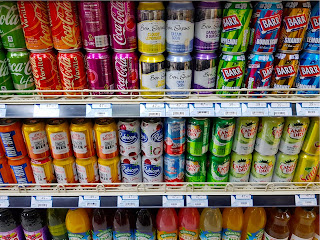
Ainslie, A. (2021, February 22). The Truth About Vaccines, Calgary, Canada [Photograph]. Canva. https://www.canva.com/design/DAEW1dhcPVw/IKULcdwmGoXR2WxYSIuaqg/edit#
What makes fizzy drinks taste fizzy? When carbon dioxide gas and water react, they produce a weak acid, called carbonic acid. Carbonic acid is what is in your soda or any drink with bubbles. Carbonic acid stimulates the same taste receptors as the ones that are triggered by cinnamon and mustard and it is what gives rise to that prickly sensation in your mouth. If you have ever heard your dentist mention to you that it is the soda that you drink that is ruining the enamel on your teeth, take comfort in the fact that it is not carbonic acid that is the culprit. Hint: It is Red Bull that is the worst offender. Carbonic acid has a pH of 4.2, giving carbonated water a pH of 4.5. This is slightly acidic, but certainly not as acidic as Red Bull, which is 3.3. Where can you find carbonic acid? The first place you can find it, is in you! Carbon dioxide is present in the blood and combines with water to form carbonic acid, which is exhaled as a gas by the lungs. The rate of your resp...
Ethyl Alcohol (Ethanol): What Gets Us Drunk? Ethyl Alcohol (also referred to as Ethanol) - more commonly known as drinking alcohol to the majority – has the structural formula C 2 H 6 O. In low doses, Ethyl Alcohol tends not to be incredibly toxic, despite the adverse effects on the body. Beer tends to contain anywhere from 4% to 9% alcohol in volume (this relates to the drink having 4mL to 9mL of pure alcohol for every 100mL of the drink), other alcohols such as wine can have upwards of 15%, or even 20%-40% for liquors (D. Klimaszyk et al. 2014). The pleasurable effects you get from drinking alcohol come from the decrease in inhibiting the neurotransmitter dopamine . To make ethanol – for use in drinking – grains, fruits or vegetables go through a process known as fermentation. Wine and ciders will be more commonly produced by fermenting fruits, whereas beers and spirits get their alcohol content from cereals such as barley and rye. This process stimulates the reaction between the...


Comments
Post a Comment